
"Photo-esque"
Rebecca Nunes on the new APHE and what it might offer all teachers of photography.

The Association for Photography in Higher Education is now the Association for Photographic Education. The name change carries a broadened remit. APHE now serves teachers across secondary, further and higher education, where for some years it served only those in HE. Rebecca Nunes, who chairs APHE and is Associate Professor in lens-based media at the University of Staffordshire, calls it a return. The Association began as something broader, contracted into HE for a long phase, and is now opening out. The whole forest needs care, she says, not just one of its rhizomes.


I have been troubled by how little dialogue there is between photography educators across schools and higher education. Whenever I’ve been lucky enough to work with colleagues in other settings, I’ve found the experience illuminating and hugely rewarding. My conversation with Becky was partly prompted by a shared sense of the need to forge better connections.
What the care Becky talks about looks like in practice, particularly for the secondary teacher who is often the only photography specialist in their school, is the open question of the next year or two. We talked about what photography education is for in a visual culture saturated with what Becky calls photo-esque images, and what a small subject association can do for teachers working across very different sectors and pressures.
APHE has recently broadened from higher education to all photography teachers. What were the reasons for the shift?
Well, strangely, when looking back over the APHE archive, it seems this is not so much a shift as a cycle. The Association has morphed from being something incredibly broad at the outset, though phases of being very specifically aimed at HE institutional membership, and now we are again aiming to support those who teach photography across pathways and stages. Primarily we see the need for a “big picture” approach. Photography education is an ecology and it does not make much sense just to support one rhizome when the whole forest needs care. (Mixed botanical metaphors there, my apologies!)
What do you think photography education is for?
O.K, my personal view is that learning about photography in its expanded sense is an empowering and emancipating process for the learner and the educator, both. You cannot effectively ‘teach’ photography without having a wide-ranging set of conversations that touch on pretty much every facet of human (and more than human) experience, which I think is hugely needed in today’s world.
I also think photography education connects outwards to a whole host of other skill-sets (both “soft” and hard) that can support people to have better experiences in life, and to be more conscious citizens. Institution-speak would rather I frame this as “employability”, but I don’t personally think that word has a huge amount of value in relation to the real-world experiences of our graduates.
Finally, I think it should be the default setting that photography education empowers learners to conceptualise and execute strong, rigorous and impactful images, in whatever “genre” they wish them to circulate.
How would you describe your educational ethos?
I have touched on it above. In a nutshell, I am an exponent of Gert Biesta’s “world-centred” education, where photography can be part of “the ongoing exploration of what it means to exist in the world”.
Can you tell me about a moment when that came alive for you in your teaching?
Honestly, I don’t know if there’s one “eureka” moment I could describe. Working with students in the studio and helping them to understand their own concerns in relation to wider cultural and artistic discourse tends to be more of a slow-burn I think, and sometime students arrive at their “eureka” moment literally years later. But I could reference the module I facilitated in Aotearoa where we took art and design students on an immersive learning experience on Ngāti Rangi tribal lands; what is called noho marae, or a communal living and learning experience where guests and hosts sleep, eat and work together towards a shared understanding. Over several years these groups of students came to understand more in 5 days about their positions in relation to colonisation and environmental pressures than anything we could deliver in a classroom.

The discourse around AI and photography has settled quickly into a defensive posture, photography as the threatened authentic image. Where does that frame help, and where does it mislead?
I’m not sure that’s how I have been reflecting on the threat of AI: In relation to GenAI I am more concerned about a sort of circling around the plughole; endless derivations of derivations leaching all the world-based juice out of pictures. But questions about the “authenticity” of lens-based imaging have always been and should always be part of everybody’s lexicon and I think this is an opportunity for photo-educators to lead on framing these conversations in public forums.
The name of the association uses the adjective “photographic,” which describes a register or quality that AI images can also possess. So the defence can’t be that AI is not capable of being photographic. How do you teach photography when looking at the world is no longer a precondition for making images that look like photographs?
I’m not trying to “defend’ against AI I don’t think. Synthetic images can be “photo-esque” (I’m claiming that term!) I don’t think that’s the same thing as being photographic. As for how we teach photography in a post-AI world, photography has constantly had to be rethought as being ‘post-something’. I think that part of belonging to a community of experts in their field, like the APHE, is that we will figure it out together.
What does APHE offer that an organisation like NSEAD might not, especially for the secondary school teacher who might be the only photography specialist in their school?
What we can offer is focus on and commitment to our subject, primarily a level of expertise in photographic education that wouldn’t be found in a more general Art & Design organisation. It is not an either/or proposition though, hopefully. Our membership fees are considerably lower and so belonging to both could be an option. Finally, I’d say that at the moment we’d like teachers to help us answer this question in ways that will make membership of the APHE genuinely valuable to them. We want to develop resources and opportunities for CPD that will offer concrete tools for their working lives, and we can’t do that by guesswork, so we’d love to connect and get better informed about the day-to-day challenges and how we can help.
How is APHE changing and who is it for?
We have a guiding set of aims:
Advocacy for photographic education
Developing the membership, outreach and accessibility
Understanding the impact of emerging technologies
Promoting sustainability
Here’s who we are for:
Individual membership
Anyone working in full- or part-time HE, FE, or Secondary photography education, including technical staff.Post-Graduate Research Students
For all institutionally affiliated PGRs with an interest / involvement in Photographic EducationFriends
Individuals working in non-teaching roles, or otherwise aligned with the aims and intentions of the APHE (e.g. retired former colleagues)We also offer organisational membership to charitable or commercial organisations who wish to support our aims and/or connect with our members, but I am not sure we are “for” them. Having said that we are building on our relationship with the AOP and I think this will grow in importance over time.
What is the July conference asking people to think about?
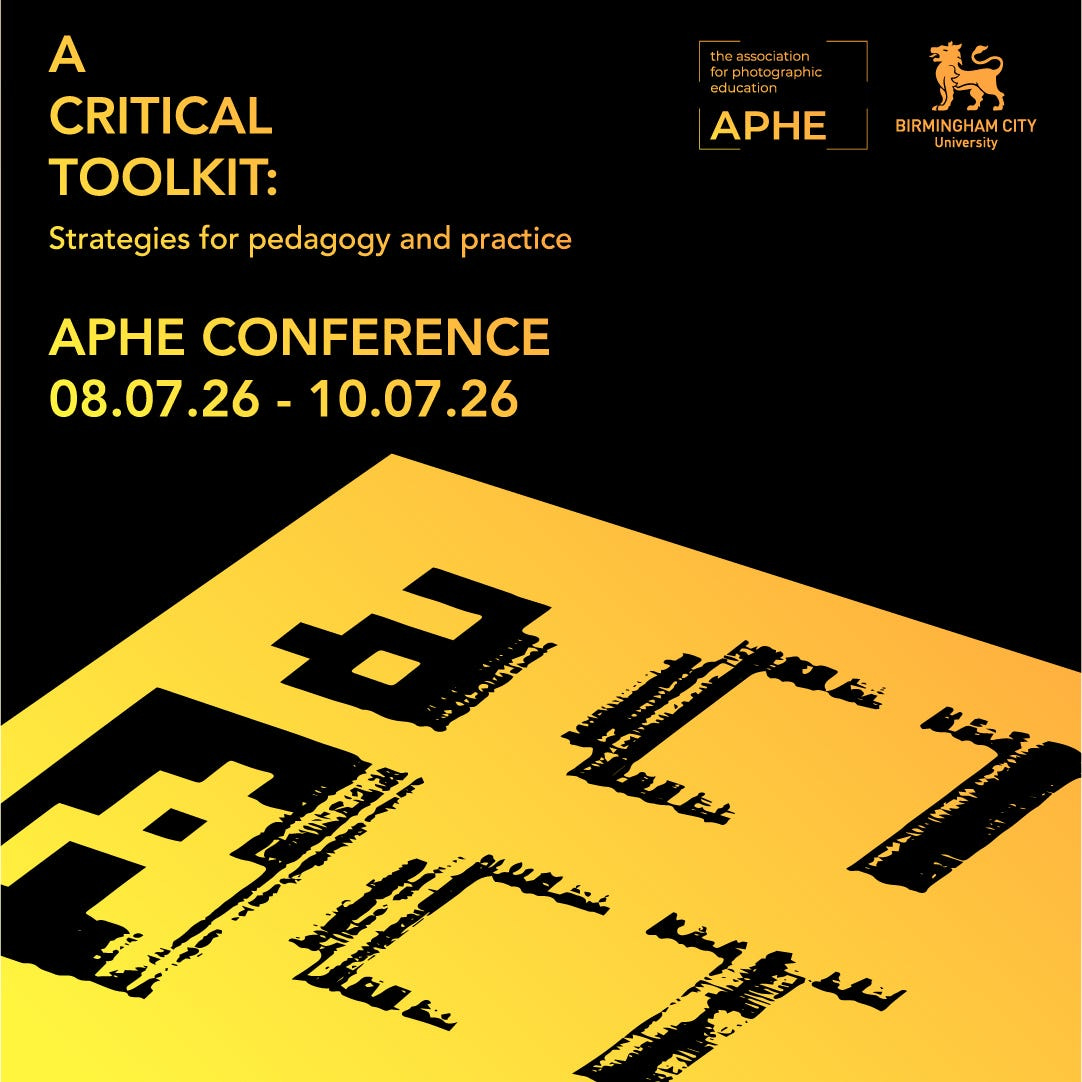
In July we are aiming to provide a really useful set of talks and discussions that will give our members something concrete to take back into their working lives. The title of the conference is A Critical Toolkit: Strategies for pedagogy and practice.
With this theme we hope to emphasise practical problem solving without sacrificing enquiry and critical thinking.
Specifically:
We are focusing on photography technicians over a morning, what they can tell us from the “engine room” and how we can work better across teams to think (at least 5 minutes) into the future.
We will also have a session devoted to the “APHIES”, a series of pecha-kucha format case studies from members highlighting good photo-pedagogic practice. This is run as a peer-reviewed competition; the most highly-scored talk will present at the SPE conference in the U.S.A (online) in 2027.
Panel discussions (challenges within the ecology: schools-colleges-HE-the world)
Individual talks via an open call, and plenary speakers.
Five years from now, what would success or failure feel like for APHE?
Well, 5 years from now is a loooong time in the current accelerated polycrisis we inhabit. However, if lens-based visual literacy had become more widespread, and parents and learners understood more fully the impact and benefits of a world-centred art & design education, then I’d like to think that we would have been part of those positive changes.
Failure, on the other hand, might look, on a small scale, like an under-resourced volunteer-run organisation petering out, as it nearly has several times already in its history. On a larger scale, well, failure would be the erasure of photography and, in a wider sense, the arts from the curriculum and a sea of A.I slop and uncritical audiences everywhere we look, I guess.
A secondary school photography teacher and an HE photography academic often inhabit different working weeks, different vocabularies, different relationships to research and very different student bodies. APHE is now formally responsible for both. What can the association concretely do, in its first year or two of the broadened remit, to close that gap? And what would you want a head of photography in a sixth form to be able to say about APHE that they cannot yet say?
The first concrete actions are part of this Q&A; opening an invitation to dialogue. We hope that teachers can see the benefit of being part of a broader conversation about photography and education, where there are opportunities to gain skills, be inspired and feel connected. The APHE is an organisation run for and by its members. In a year or two I’d love a Head of Photography to say that they are on the executive team of an organisation that has real impact on policy and is improving photography teachers’ working lives.
Thanks to Becky for the conversation. APHE is still in the early phase of its broadened remit and the offer to secondary teachers is still being shaped. That’s precisely why the moment to join is now, while shaping is still possible. APHE membership is open to anyone teaching photography in secondary, further or higher education.
The summer conference, A Critical Toolkit, takes place at Birmingham City University on 8, 9 and 10 July. The intention is to make attendance affordable and a small number of needs-based travel bursaries will be available. There will also be streaming access to some of the sessions.
If you are the only photography specialist in your school, this is the association that has just changed shape to serve you.
Worth a look.
These posts will always be free but, if you enjoy reading them, you can support my analogue photography habit, and that of my students, by contributing to the film fund. Thanks to those of you who have already done so. All donations of whatever size are very gratefully received.