
This post is part of a short series responding to Italo Calvino’s Six Memos for the Next Millennium.
I taught my first ever lesson from a slide carousel. I was twenty-two, halfway through a literature and art history MA, when I was recruited by a local college of art and design to teach a course on Victorian painting. I was a callow postgraduate who knew less about the subject than I pretended. Each week I would go to the slide library, select the images I needed, load the mounts in what I hoped was a defensible order, turn out the lights and talk.
It was terrifying. Undergraduates of various ages, some of them older than me, sat in the dark while I advanced through the images. One afternoon a lecturer came into the room, assumed I was a student and began dismantling the projector on the grounds that his need was greater than mine.
I still love slide projectors. I’ve used them at school. Students have cut up old 35mm transparencies, bought cheaply on eBay, and recombined them into constructed landscapes, inspired by Dafna Talmor. When I come across a projector in a gallery I feel a small lift. And when I began taking photographs more seriously in the early 1990s I shot slide film almost exclusively, mostly Kodachrome, which came back in those yellow oblong boxes through the post from a lab in Paris. I’ve just got all of them out of storage and scanned them.
A slide is backlit, like a screen. The light comes through the image rather than bouncing off it, which is a different relationship from the one you have with a print, and it’s now how most photographs reach most people.
The knot, not the heap
Calvino’s fifth value is the one that sounds most familiar. He devotes the lecture to the contemporary novel as an encyclopedia, as a method of knowledge and, above all, as “a network of connections between the events, the people, and the things of the world.”
The obvious photographic response to this is the Internet and the trillions of annual uploads, the archive expanding faster than anyone can look. Penelope Umbrico, Erik Kessels, Taryn Simon have all found ways to make that visible, and machine vision now sorts it at a scale no person could. But I do not think Calvino is talking about quantity. The Internet is not his multiplicity. It’s closer to being its opposite.
His central example is Carlo Emilio Gadda, whose detective Ingravallo maintains that catastrophes are never the result of a single cause. They are a vortex, a whirlwind of converging motives. Gadda has various words for this: knot, tangle, muddle. The point isn’t that there’s a lot of it. It’s that everything is tied to everything else. Calvino admires Gadda’s “frenzied desperation”, the tension between rational exactitude and frenetic distortion that he thinks underlies every act of knowing. He compares this with the cool mathematics of Musil, and then Perec, whose Life A User’s Manual moves through a Paris apartment building room by room following a knight’s move across a ten by ten grid, ninety-nine chapters where there should be a hundred, a loophole left open on purpose.
A heap isn’t a network. A pile of images accumulates; a knot connects. The web is an enormous heap that mostly fails to become a knot, which is why it’s exhausting rather than encyclopedic. What interests me is the other thing where lots of images are held in careful relation to one another.
An Educational Archive of 2863 Slides
Frido Troost taught art history at the Gerrit Rietveld Academie in Amsterdam. He ran a shop called the Institute for Concrete Matter which dealt in photography of every kind, daguerreotypes through to family albums. He died in 2013, and in 2020 Art Paper Editions published every slide he had used in his teaching, all 2863 of them, laid out nine to a page in the same non-hierarchical arrangement he used in class. There is an essay by David Campany. There are no captions.
I bought it because of the carousel.
It’s not an easy book to love unless you have stood in the dark hoping that what you have assembled makes some kind of sense. What it gives you is the shape of one man’s looking, in Amsterdam, after the war, with all the fixations and blind spots that implies. Advertising, erotica, art objects, portraits, scientific illustration, cinema stills, other people’s snapshots. In the accompanying essay, David Campany quotes a line of August Sander’s from a letter to a friend:
A successful photo is only a preliminary step toward the intelligent use of photography. Photography is like a mosaic that becomes a synthesis only when it is presented en masse.
The single image is preliminary. The meaning is in the mass and in what ends up next to what.
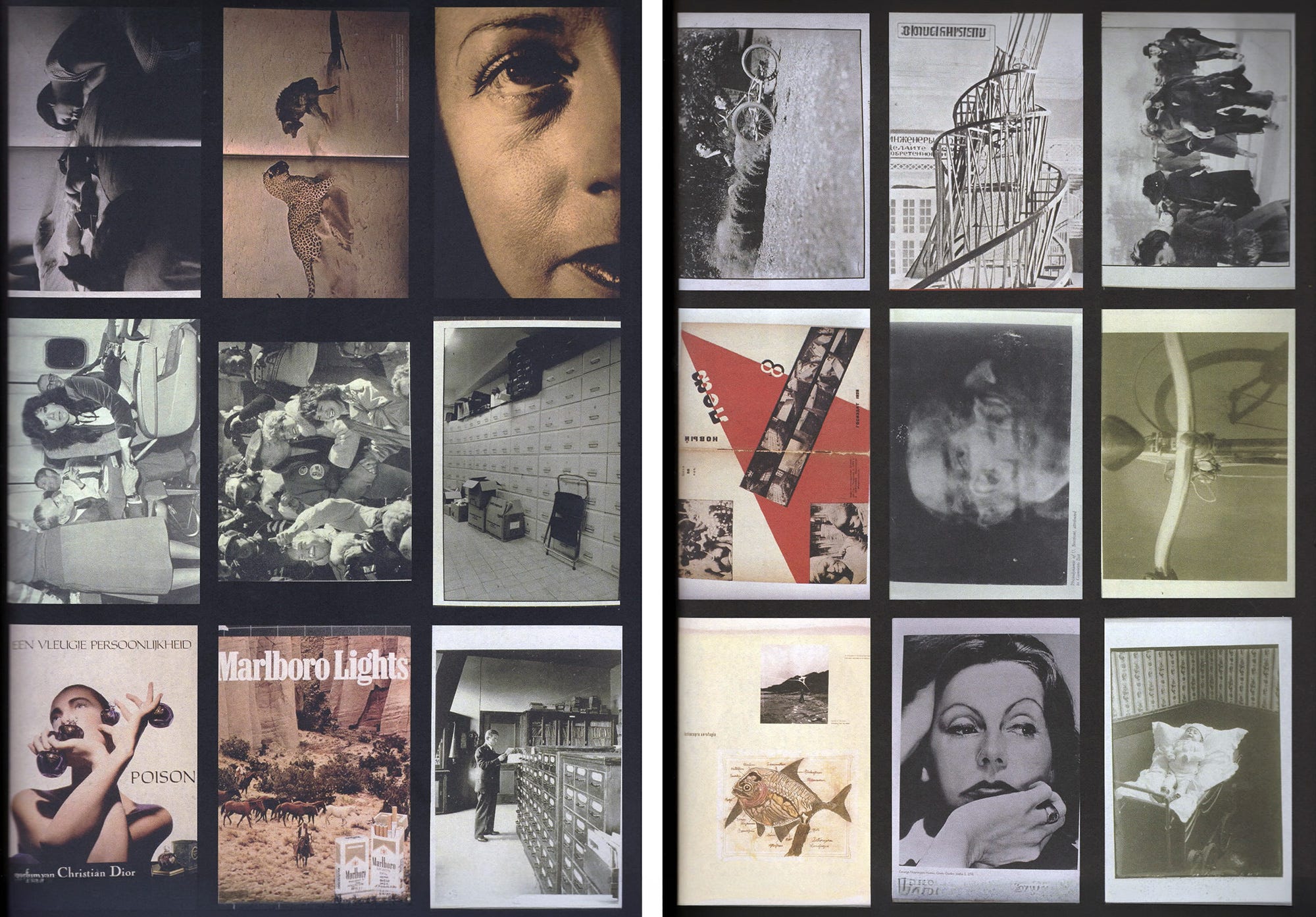
Campany also describes his own habit of assembling pictures for a talk before he has decided what he might say about them.
That moment when the visuals are present and the words have not yet taken concrete form on the page, or in the mouth, is special. It is full of possibility and imagination.
He often waits, after showing a sequence, before he starts to speak. He suggests that reading Troost’s book is like that, the “mute time with the images, before the words begin to flow.”
On the left of the spread I have chosen (above) there is a Dior advertisement for a perfume called Poison, a Marlboro Lights billboard with horses, and a man standing at a bank of card index drawers. Above them a room full of filing cabinets, a crowd of upturned faces. Above that, a woman’s eye in close-up, a leopard, a baby on a bed. On the right there is a Russian constructivist magazine cover, a spirit photograph, a scientific plate of a fish with its parts named in Latin, Garbo and, in the bottom corner, a baby in a cot.
All the same size. All in the same black grid. Nothing to tell you how to weigh them.
There is a review by Jörg Colberg which points out, fairly, that a good deal of what Troost taught with runs along the lines of the male gaze or standard colonial photography and that the book reproduces it without correction. It’s a dead man’s slide library, published as it was. That’s OK. We don’t need to tidy up historical image sets, and the editorialising that gets added now, in case anyone is offended, tends to destroy the evidence. What one man chose to teach with is a document of how he saw and the prejudices are part of it. But the curated grid offers no protection against its own contents. A dead child and a cigarette advertisement are given exactly the same nine-per-page democracy. The method that lets you see how a mind worked is the same method that lets old poison pass as natural gas.
Two of the slides on that spread are photographs of archives. Troost chose pictures of filing cabinets to teach with and they sit in a book which is itself a filing cabinet.
Ein Dorf 1950-2022
In the 1950s Ludwig Schirmer was the master miller in Berka, Thuringia. He was a self-taught photographer and he documented the place, the work, the festivals and the fields. He later became one of the best known advertising photographers in the GDR. He died in 2001. Among his effects were a few prints and a great many negatives of the Berka pictures, which his daughter and son-in-law began printing in their own darkroom and which turned out to be very good indeed.
The daughter is Ute Mahler, who grew up in Berka. The son-in-law is Werner Mahler, who in 1977 chose Berka as the subject of his diploma at the Hochschule für Grafik und Buchkunst in Leipzig without knowing that his wife’s father had photographed it twenty years earlier. Twenty years after that, in 1998, Stern asked Werner to go back and photograph the flowering landscapes Helmut Kohl had promised. That work was never published. In 2021 and 2022 Ute went back and made portraits of the young people of the village, some of them the great-granddaughters of the people her father had photographed in the fifties.
The publisher’s description of the book lists these as a series of coincidences, and then, arriving at Ute’s return, notes that this one wasn’t a coincidence at all.
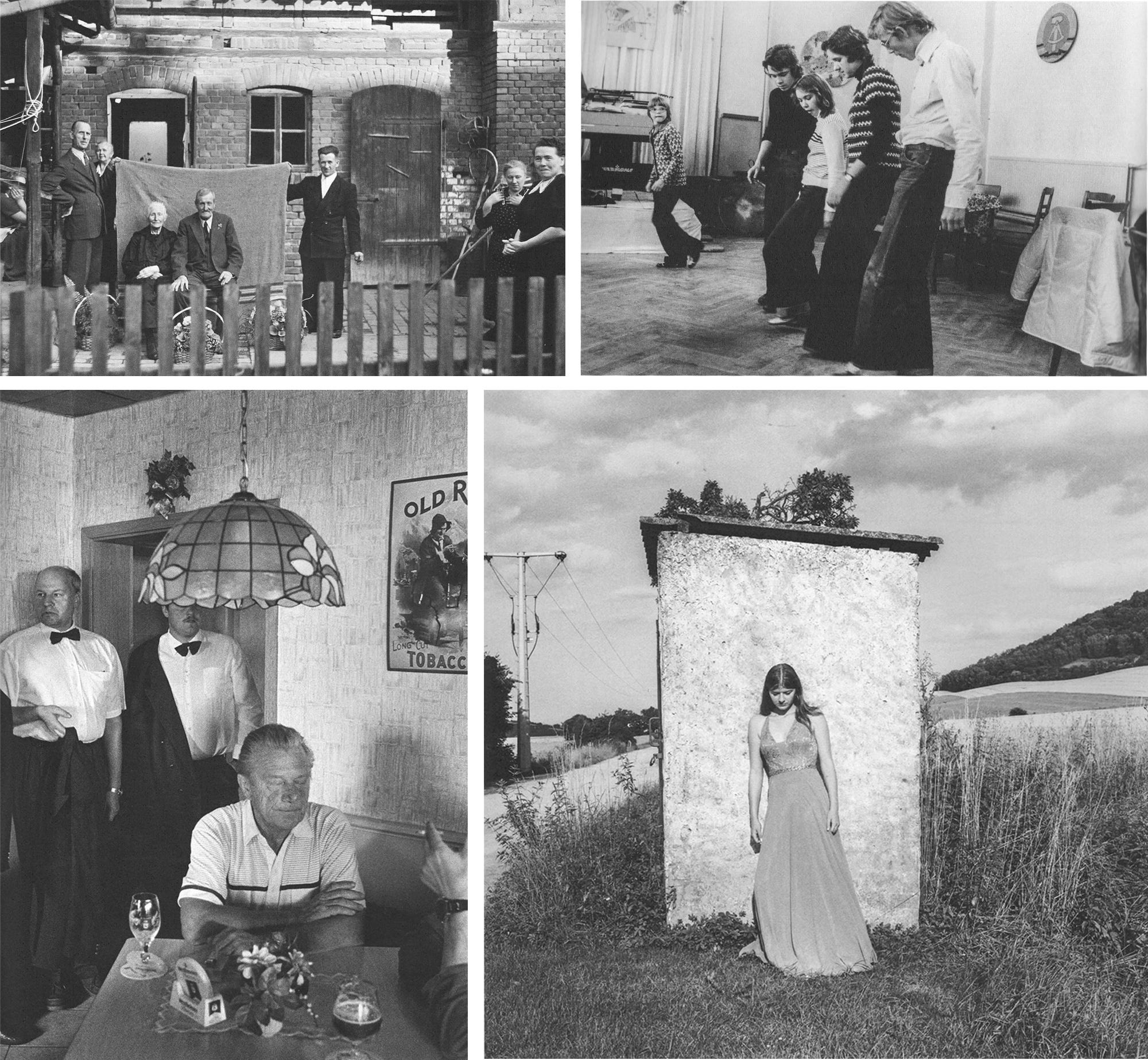
The four pictures I’ve put together here span the seventy years. A family in the fifties, arranged outside a brick farmhouse behind a picket fence, two of them seated, someone holding up a cloth. Werner’s teenagers in 1977, in a hall under the GDR emblem, flared jeans, half dancing, not quite looking at each other. Werner’s men in 1998, bow ties, a bar, an American tobacco advertisement on the wall where the state emblem used to be. And Ute’s girl, alone in a long dress in front of a whitewashed shed, a power line behind her and a field of wheat.
Michael Grieve, reviewing it, writes that photography projects which collaborate with the deceased “have the potential to breathe new life and recontextualise how we understand the past, the present and project with unease into the uncertain future”, and that “not only is society in perpetual motion but the meaning of photographs are always constantly in a state of flux.”
A photograph never fully closes, which is exactly why it stays available to be reordered, reprinted, or given to a daughter to finish. Schirmer joins a conversation he could not have known he was part of. And the flux doesn’t care what it’s used for. Berka is in a part of Germany where the AfD now tops the poll. A loving return to a home village is one edit away from blood and soil and the identical photographs, in a slightly worse mood, would make the reactionary version of this book without a single change of content. The looseness that lets Ute honour her father is the looseness that lets anybody appropriate him.
The Archive of Bernard Taylor
Bernard Taylor was an amateur photographer in Hastings-on-Hudson who made what he called worksheets, photographs mounted on card and annotated with quotations from Gertrude Stein, Tanizaki, Mary McCarthy, Pasteur and Mill, together with cryptic captions of his own. After his death six boxes of this material were bought for forty dollars at an estate sale by a filmmaker called Peter Ward, who selected and edited them, wrote a preface, and could not resist adding his own notes on local history. The publisher then added an afterword which critically re-examines Ward’s editorial decisions and describes the agonising process of preparing the edition.
But Bernard Taylor doesn’t exist and neither does Peter Ward. The title page clearly states: conceived, created and designed by Tom Lecky.
Lecky is an antiquarian bookseller. He’s spent years handling provenance for a living, the bookplate, the inscription, the laid-in letter, the marks that turn one copy of a printed multiple into a unique object. In an interview with BOMB, published under the title “The multiple becomes unique”, he says the book uses many of these same strategies, from anagrams and acrostics to rigid formal grids.
The photographs are Lecky’s own. What he’s fabricated is the apparatus that vouches for them. The provenance, the chain of custody, the disputing editors, the scholarly agonising. He’s manufactured the machinery by which an archive gets certified as real and then he lets you watch it wobble.
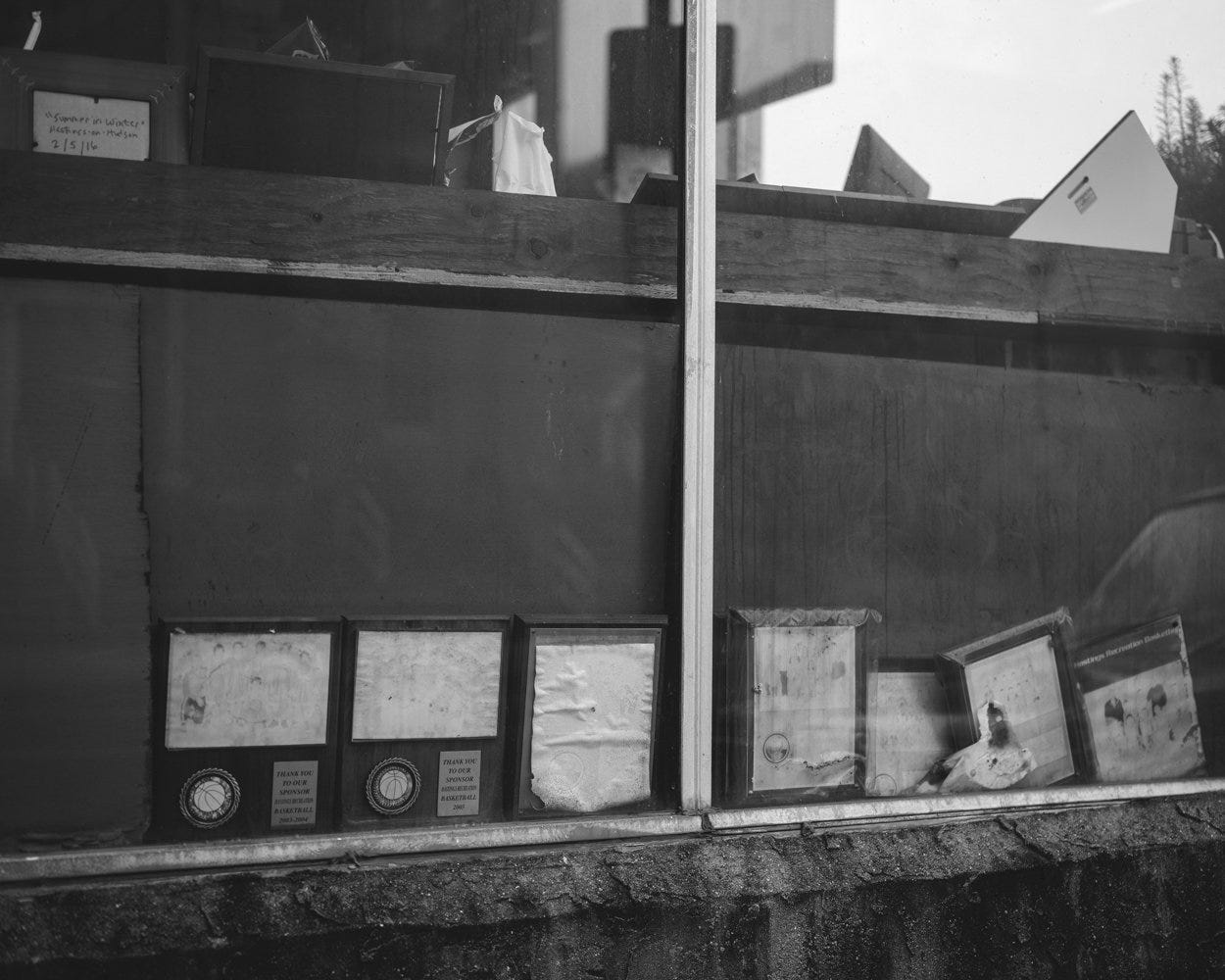
After I’d bought the book, I read Eugenie Shinkle’s review in C4 Journal. I’d been researching connections between the Oulipo and photography at the time. I’d spent some time with Bernard Taylor’s archive and felt something was off without being able to say what. So I eventually wrote her a long rambling email asking about the structure, and adding that I’d wondered whether the whole thing might be an elaborate hoax. She wrote back to say I’d solved it, that she had worked it out herself when things stopped making sense, that the interview with Peter Ward in her review was a lightly edited transcript of her email exchange with Lecky, and that she had decided, in the spirit of the game, not to out him. She added that the relationship between the text and the images would go on puzzling her for a long time to come.
Most puzzles die when they’re solved. This one doesn’t.
Shinkle’s review contains a useful definition of authorship:
If, by ‘author’, we understand the person who shapes the presentation of a work (if not its interpretation), then The Archive of Bernard Taylor has at least two and potentially many more authors involved. The ‘meaning’ of this book isn’t just to be found in the photographs, or in the ephemera, or even in Ward’s strange addenda, but in the hidden structures that hold them together.
One of the image captions reads “Three Heresies Hit a Whom”. The photograph is a street at night, a house, a tree. Nothing remarkable. The caption announces itself as a cipher and withholds the key, and after a while you stop trying and simply enjoy the sensation of an order you can feel but can’t reach. That’s the book’s method at the scale of a single page, and it is why the constraints work. They’re not there to be solved but to be sensed and enjoyed.
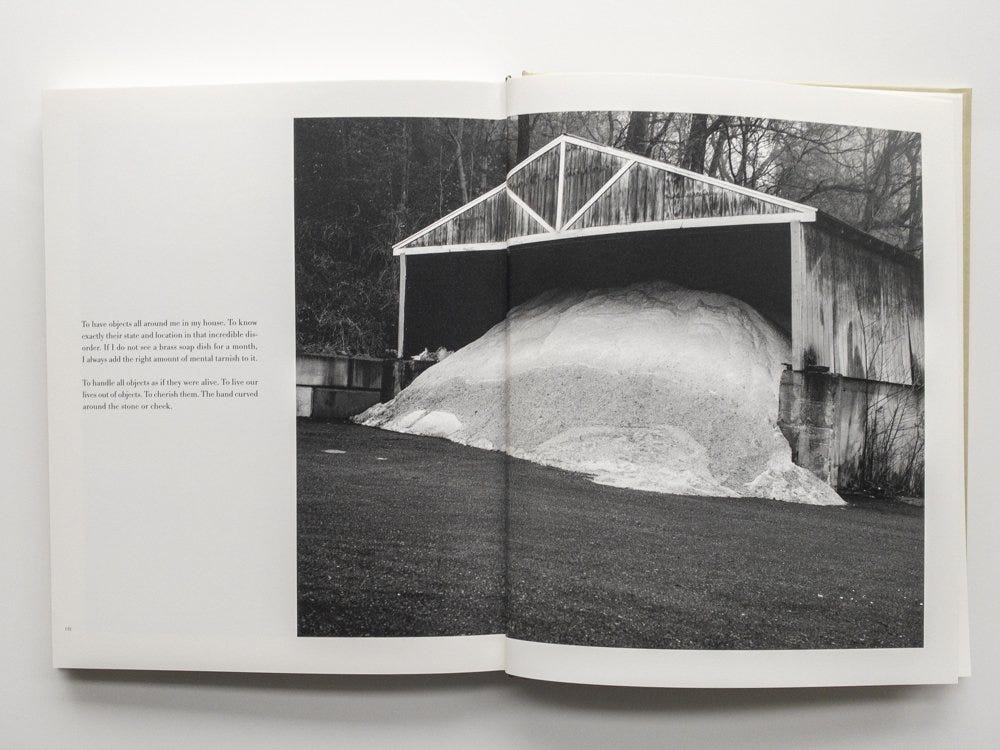
On one spread, a low white heap of something, salt or sand, spilling out from under a shed roof, fills the right-hand page. On the left, in small type:
To have objects all around me in my house. To know exactly their state and location in that incredible disorder. If I do not see a brass soap dish for a month, I always add the right amount of mental tarnish to it.
Adding the right amount of mental tarnish to an object you can’t see is what an archive does to the dead and what Lecky has done to a man who never lived.
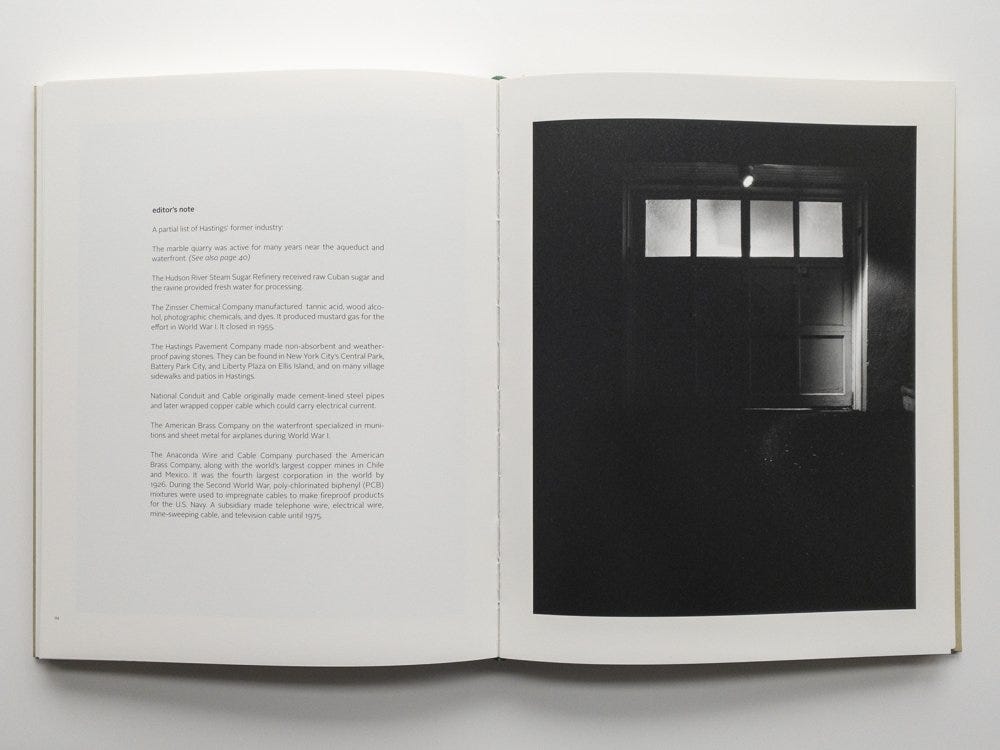
On another spread there’s an ‘editor’s note’, a partial list of Hastings’ former industries. The marble quarry. The steam sugar refinery. The Zinsser Chemical Company, which manufactured tannic acid, wood alcohol, photographic chemicals and dyes, and produced mustard gas for the effort in the First World War. The Anaconda Wire and Cable Company, which bought the American Brass Company along with the world’s largest copper mines in Chile and Mexico, and whose PCB mixtures impregnated cables for the US Navy. Facing it, a photograph which is almost entirely black, a garage door with four lit panes and almost nothing else visible.
Photographic chemistry sits in a list with chemical weapons and colonial copper and a picture beside it that’s almost all deep shadow.
What keeps all this from being a display of cleverness (it easily could have been) is that Lecky trusts the reader. Nothing is over-determined. The erudition (antiquarian, chemical, geological, local, literary) is worn lightly and the book is witty in a way that never becomes a performance. It smiles rather than laughs. A laugh announces the joke. A smile waits for you to catch it and lets you be pleased with yourself when you do.
If there’s one quality I would want to pass on to students, and I find it in most of the work I love, in music and writing as much as pictures, it’s that. Knowledge without solemnity and wit that punctures rather than performs.
The encounter
Troost’s grid asks you to join the dots. Seventy years of a village sit uncaptioned and let you feel the time yourself. Lecky trusts you to notice the conceit. The gap between images and words, to reiterate David Campany’s phrase is “full of possibility and imagination.” It’s what happens in a good classroom.
I’m less worried about machines making hollow work, since they will make good work soon enough, or that authorless things are less valuable, since I don’t believe that value is simply found in an author’s pulse. There are plenty of boring photographs, dull novels and silly songs. What I worry about, mostly, is the other side of the encounter. That we stop showing up. That the connections get made for us, that the gap gets filled before we reach it, that the pile arrives pre-sorted and we never enter the space where the meaning actually happens. The threat is our own withdrawal.
I’ve chosen the images on this page. Eighteen slides out of two thousand, eight hundred and sixty-three. Four photographs from a village. Two spreads and three photographs from an archive running to a hundred and forty-one pages.
Calvino ends his lecture as follows.
Who are we, who is each one of us, if not a combinatoria of experiences, information, books we have read, things imagined? Each life is an encyclopedia, a library, an inventory of objects, a series of styles, and everything can be constantly shuffled and reordered in every way conceivable.
It’s a humane thought and also a disquieting one, because the arranging and reordering of everything is now industrial and the sentence describes both the richness of a person and the operation of a machine trained on all of us.
What it doesn’t settle is who is shuffling the deck.
These posts will always be free but, if you enjoy reading them, you can support my analogue photography habit, and that of my students, by contributing to the film fund. Thanks to those of you who have already done so. All donations of whatever size are very gratefully received.