
No Place
We didn't dream it.
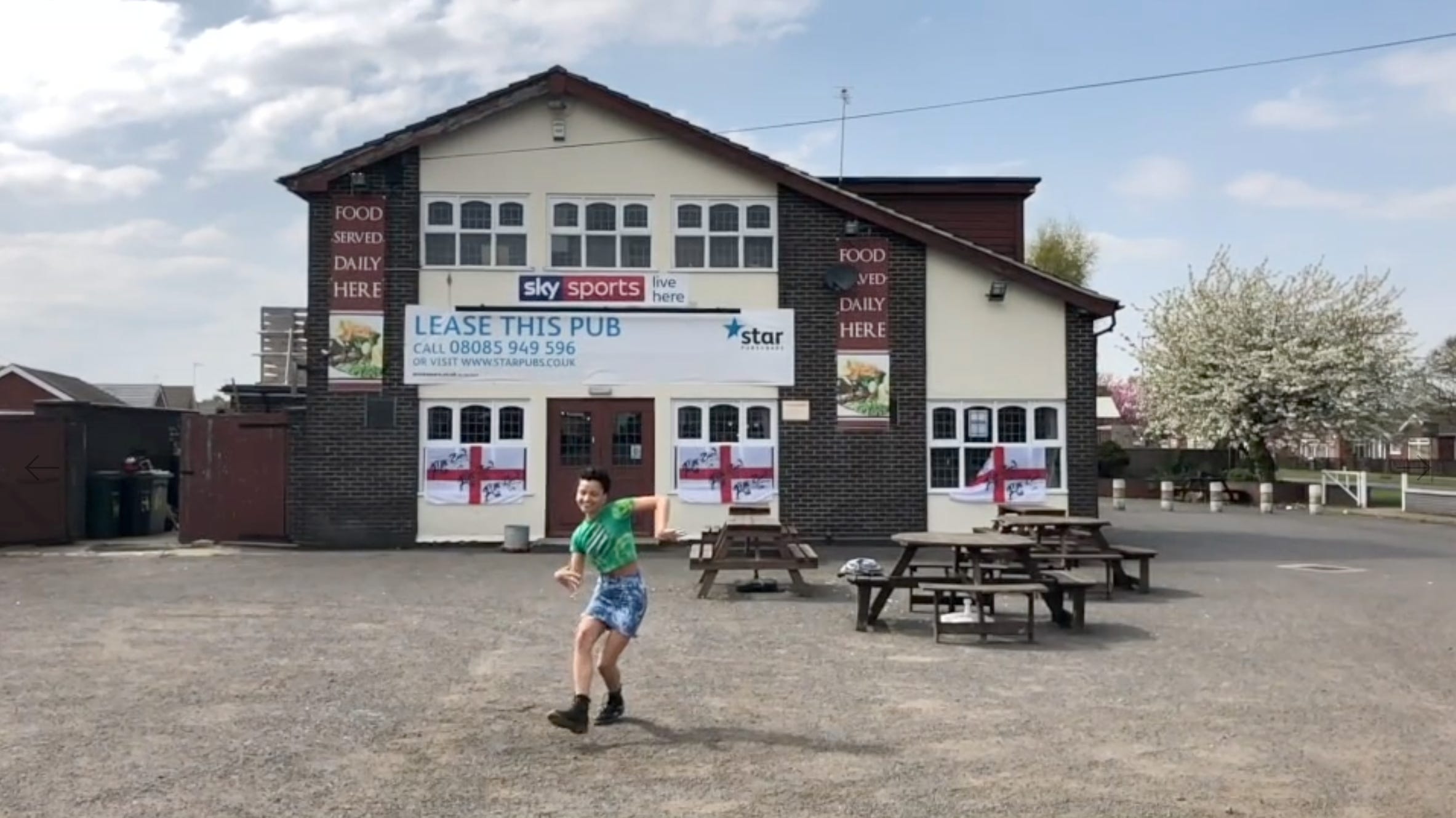
I first saw Rene Matić’s work in 2020, at the Bloomberg New Contemporaries show at the South London Gallery. I remember a film of them dancing in Doc Marten boots outside a pub festooned with St. George flags. It was the best thing in the show, by far. What I remember is the feeling it gave me. Something spontaneous, joyful, but also complicated and angry. Rude, in fact.1 The soundtrack had Matić reflecting on images of the queer black body and the quest for liberation.
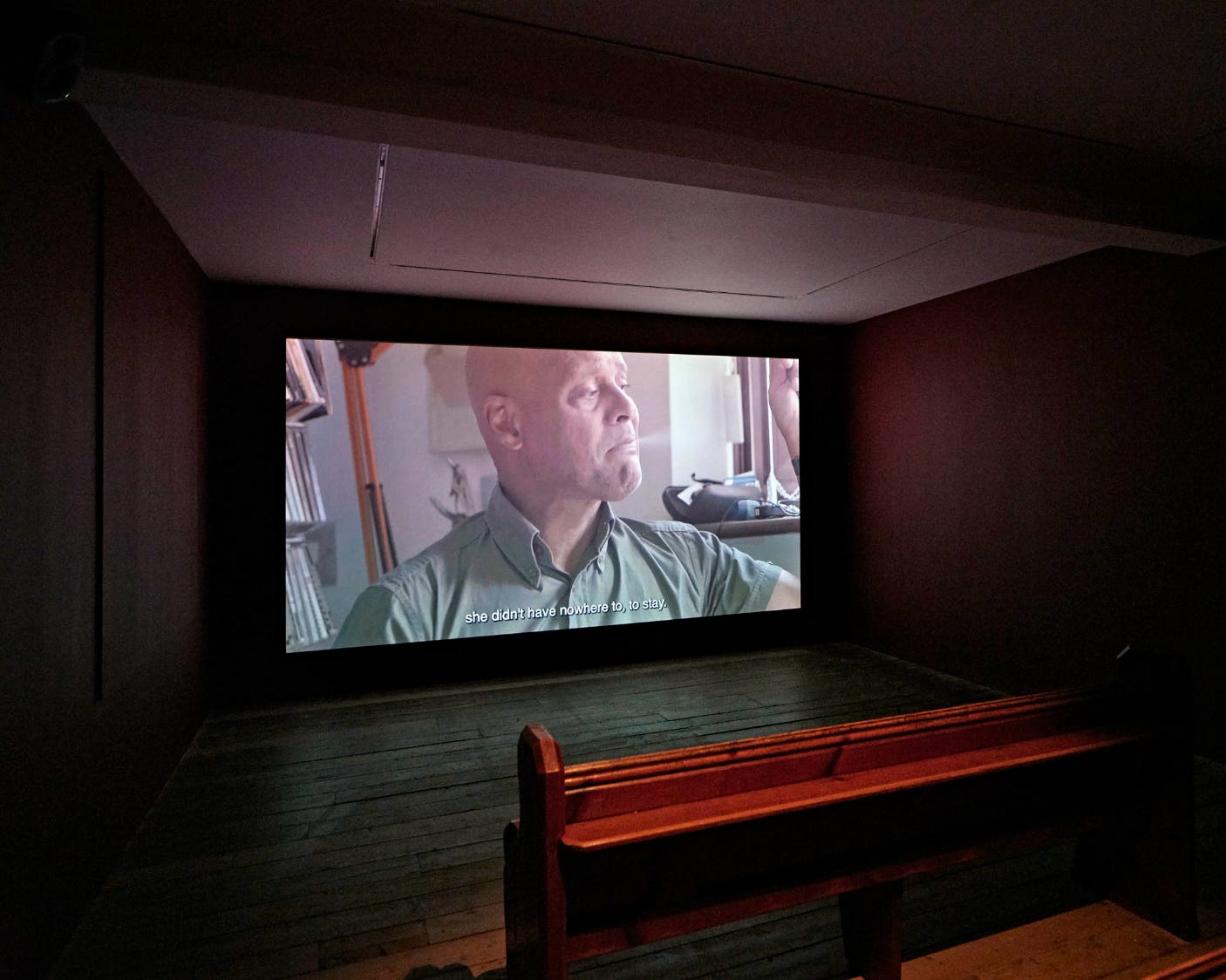
Two years later, they had a solo show at the same gallery. upon this rock explored skinhead culture, faith, family and the figure of their father, Paul, a Black man in a subculture born from Caribbean and white working-class exchange. There were bronze crucifixes, a hand-stitched flag, family photographs and a thirty-minute film that left me sitting on a church bench feeling like I’d been told something important by a stranger on a train. In 2025, they were the youngest artist nominated for the Turner Prize.
The SLG is my local gallery. I’ve been following Matić’s work since that first encounter, with a mixture of admiration and genuine uncertainty about what I was looking at. So when I heard they’d been shortlisted for the Deutsche Börse Photography Foundation Prize, I went to The Photographers’ Gallery expecting to be challenged. I was right to expect it. But I wasn't prepared for how much of the challenge would come from myself.
Now, in March 2026, I’m standing in front of AS OPPOSED TO THE TRUTH, and I’m troubled and I’m trying to be honest about why.
The photographs are displayed behind sheets of glass, fastened at the corners, leaning against the wall on a long shelf. They overlap, producing a collage-like layering. Some are partially obscured by others. The images are diaristic, snapshot-like. Friends kissing at festivals, a figure with red hair stretching in a dark room, a street shrine with flowers and a Jamaican flag, graffiti reading “Steal From the Rich,” a memorial card with “Dad, Our Hero, VIP, Legend & Superstar.” The photographs of pro-Palestine marches sit alongside images of intimacy and celebration. A flag bearing the words “No Place” and “For Violence” hangs from the ceiling above the whole installation. A soundtrack plays. Church bells, protest chants, voices I can’t quite make out.2


Two things compete in me as I look. And I'm not sure either of them is entirely trustworthy.
The first is scepticism, or something a bit harder. A suspicion that the roughness is calculated and the political content is a kind of cultural credential. That the photographs, taken individually, are just snapshots, no more considered than anything on anyone’s phone. Matić enjoys using a basic point-and-shoot 35mm camera they found discarded in an empty studio space. The insistence on identity, on lived experience as sufficient subject matter, could be a dead end. Waldemar Januszczak in the Sunday Times saw “empty sloganeering” and “wonky photos,” and accused Matić of being “another artistic narcissist obsessed with identity issues.” There might be sloganeering but I don’t consider it empty. However, his charge about “the absence of any transformative ambition that might turn the good causes into good art” is still bouncing around in my head and won’t leave. I am a white, cis-gendered, middle-aged photography teacher, with particular tastes and visual preferences. My instincts are somewhat conventional. I know this. But knowing it doesn’t dissolve it. Is my discomfort with the individual images, their clumsiness, their provisional quality, what feels like a rejection of visual intelligence, a legitimate aesthetic response or just my formation speaking?
There’s a harder question underneath this one. In what sense is Matić’s work still radical, subaltern, even, when it has been fully absorbed into the mainstream art world?3 Two major prize nominations, a solo show, a book, a gallery with a gift shop. The Deutsche Börse and Turner Prize committees may be using Matić as much as Matić is using them, pushing back against the tide of anti-wokeism, claiming something relevant and contemporary for institutions that need to appear relevant and contemporary. The avant-garde becomes the establishment.
The second feeling is harder to name. It has something to do with the glass.
The photographs lean and overlap. You see through one image to another beneath it. This isn’t a photography exhibition in any conventional sense. It’s closer to a vitrine, a cabinet of curiosities, or a grandparent’s mantelpiece where the framed pictures jostle and overlap and nobody worries about the arrangement because the point isn’t the arrangement. The point is that these people exist. They are here. They have been seen.


Consider a couple of details. A person with dwarfism applies lipstick in a saucepan lid-like mirror, face painted in bright clown colours, blonde wig, mouth open, a green plastic bag occupying the foreground. Alongside, we are shown vases of cut flowers in a domestic interior. I photographed this detail because I found the colours, the shapes and textures aesthetically appealing. The ghosts of other photographs were somewhere in the mix. Arbus. Davidson. A long tradition of documentary photography that found formal beauty in marginalised lives and called it witness. It's hard to unknow what you've already seen. The memory palace is full of images you didn't choose and can't entirely account for. Matić's installation layers photographs so that each one is visible through another. My looking does the same thing, except I didn't curate the haunting. Another montage. Someone laughing in a gold jacket, phone in hand. Hovering above, a baby is expertly breast-fed, one-handed, by a mum perched on the edge of a sofa, both images overlaid on a long exposure of ecstatic clubbers bathed in red and green. The glass catches your reflection. For a moment you’re inside, layered into another world.
But am I really? Or do I feel like I ought to be inside it, because the work demands that response or because of the institutional framing? I didn’t spend long in the room. The individual images didn’t persuade me to stay. There were elements that feel like clichés, the Palestine demo, the gay kiss, the snapshot aesthetic. I think of Goldin and Tillmans, photographers for whom the photograph itself matters. Matić's images feel more like testimony than photography, which is a different ambition.
In the video interview that accompanies the exhibition, Matić articulates this precisely:
I want to be represented as being cared for. There are a lot of images of us having violence put on us out there. I want to show a counter-image. I don't quite know what that does yet. All I know is that it shows that it's possible, you know. That we didn't dream it.
My body is not in danger. I am not part of that ‘we’. In a sense, this exhibition isn’t for me. And that’s OK. What I can say about the installation is that it does something (for me) that the individual photographs don’t. The layering, the glass, the overlapping of public and private, political and intimate, sacred and profane. Nothing is more important than anything else. The kiss and the protest march and the memorial card and the baby’s head and the plastic bag get equal billing. And the glass, unframed, precarious, fragile, requiring great care and a complex risk assessment!
I’ve been thinking about all this in relation to the Surrealists, partly because I’m working on a chapter about Surrealism’s photographic legacy for a book I’m writing about photography teaching. Sontag argued that all photography is inherently Surrealist, that the camera’s indiscriminate attention, its ability to place anything alongside anything else, is itself a Surrealist act. Matić’s work is aggressively ordinary. No double exposures or dreamlike distortions. But the installation produces exactly the kind of convulsive encounter the Surrealists were after, the marvellous hidden in the everyday, or forced into collision with it. The church bells on the soundtrack were originally cast from melted cannons. Destruction repurposed as devotion. The flag hanging above (“No Place / For Violence”) reads simultaneously as slogan and description. There is no place for violence. But also, this is a place of no-place, a utopia in the literal sense, built from fragments of an alternative present for an imagined future.4
Or is this me finding the theory that makes the work legible? Matić’s practice comes wrapped in critical armature.5 Do the images rely on that scaffolding to mean anything? Would they work without it?
I remain conflicted. I don’t think the individual photographs would survive on their own. But then they’re not trying to. They function collectively, the way images in a family album work, as evidence of a life lived together.6 The formal looseness bothers me and I know this says as much about my way of seeing as it does about the work.
I’m going back. More than once, probably. Not because I’m sure something will resolve. But because I’m not sure it should.7
Walking through the other rooms in the Deutsche Börse exhibition, something else occurred to me, tentatively, as an idea I’m still testing. Each of the four nominated artists, working independently, in different countries, with different materials and concerns, seemed to have arrived at something recognisably Surrealist. Jane Evelyn Atwood spent a decade documenting women’s prisons. The work is a howl of rage, brutal and unsparing, a confrontation with confinement that recalled the Surrealists’ fascination with abattoirs and institutional violence, the raw material of a world that polite culture prefers not to see. Weronika Gęsicka’s fabricated encyclopaedia entries, visualised through manipulated stock photography and AI-generated imagery, are exquisite corpses in the original sense, playful, radically genre-bending, the serious game played with the apparatus of authority. Amak Mahmoodian’s collaborative mapping of exile dreams across fourteen countries is a dream journal made collective, the unconscious given geographic form, text and image exploring the poetry of alternative realities that displacement forces people to inhabit.


None of these artists would describe themselves as Surrealists. But the energies I’ve been tracing (chance, play, the marvellous hidden in the ordinary, the refusal to accept the world as given) are alive in all four rooms.
And there is something else. Atwood’s and Mahmoodian’s exhibitions are shot through with loss. Incarceration, exile and displacement. Lives constrained by forces beyond individual control. But loss is not what stays with you when you leave. What stays is energy. Rage, tenderness, dreams and defiance. The photographs in these rooms aren’t elegies. They don’t look back. They project forward, toward worlds that don’t exist yet but might. Toward bodies that insist on being seen and toward futures that images help to build. The Surrealist revolution failed, appropriated by advertising and fashion imagery, absorbed into the rapacious capitalist desire machine. But the ambition was never only to make strange art. It was to change the whole of life. That ambition seems to have found new bodies, new communities and new rooms.
Whether it has found art with lasting value is a question I’m prepared to leave open.
These posts will always be free but, if you enjoy reading them, you can support my analogue photography habit, and that of my students, by contributing to the film fund. Thanks to those of you who have already done so. All donations of whatever size are very gratefully received.
I think rudeness changes every day, in every circumstance. It’s essentially inspired by the Jamaican rudeboy subculture — the energy of purposefully existing outside — that I deeply know and love. But it also came to be from my own positionality, of constantly being in between so many spaces, as a mixed-race person, especially as a non-binary person. The idea of being rude, and interrupting by accident and then embracing it and using it as a tool to survive. Sarah Ahmed talks about “ruining the dinner party,” bell hooks talks about “talking back,” to me this is the same energy.
To me, that rude centre is really important, and I am constantly returning to it. It has this kind of child-like naivete in it, that I never want to lose because I believe you get a lot done when you’re naive. As the practice matures and I mature, I always want to circle back to this rudeness and remain in that spot of self-aware and unafraidness. I do think a lot of skill goes into being rude, and it’s something I’m constantly practising because a lot of it has to do with anger. Anger is very scary to me – I have been very angry in my life, and I realised it hurts me more than anything else. I think the work is learning how to navigate that, how to remain angry, but how to use it for something productive. Allowing myself this rudeness and in-betweenness, is my way of doing the work, my way of getting comfy with it.
— Rene Matić, interviewed in émergent magazine.
The sound piece 365 (2024), encountered throughout the exhibition, layers recordings of the church bells of the Kaiser Wilhelm Memorial Church in Berlin, originally cast from melted cannons of the Franco-Prussian War, later melted down again during the Second World War, with news broadcasts, a heartbeat, conversations with family, protest chants, recordings of James Baldwin and bell hooks speaking on truth, love and death, and Rihanna’s Lift Me Up, a tribute to Chadwick Boseman.
The term ‘subaltern’ comes from Gramsci, developed most influentially for postcolonial studies by Spivak in her 1988 essay "Can the Subaltern Speak?", a question she answers, essentially, in the negative. The subaltern is not simply the marginalised or oppressed but specifically those for whom the conditions of being heard do not exist within the dominant discourse.
Thomas More coined the word in 1516, from the Greek ou-topos (no-place) and eu-topos (good-place), deliberately collapsing the two. A utopia is simultaneously nowhere and somewhere worth reaching. Matić’s flag (“No Place / For Violence”) carries both readings. There is no place for violence. Flags represent nations. Matić makes flags for the stateless. “I came to flags because I didn't understand them. They come to us all the time. Their being in my work so much is me not understanding it.”
These include bell hooks whose Talking Back: Thinking Feminist, Thinking Black (South End Press, 1989) is often referenced by Matić. In the title essay, hooks writes about what it meant, growing up Black and female in the American South, to speak when not spoken to, an act of defiance that invited punishment. "Moving from silence into speech," she writes, "is for the oppressed, the colonised, the exploited [...] a gesture of defiance that heals, that makes new life and new growth possible." Also, Sara Ahmed's feminist killjoy is the person who, by naming what is wrong with a situation, ruins the mood for everyone else. "Have you ever been accused of ruining dinner by pointing out your companion's sexist comment?" is how her publisher summarises it. Ahmed argues that this disruption, getting in the way of comfortable happiness, is not destruction but world-making. The killjoy and the rudeboy are recognisably the same figure approached from different directions.
The grainy texture of blown-up photos captures a private feeling, like sharing space with someone so you could feel the heat of their skin. Getting this close to somebody is not about representation, but a calling-into-presence of strangers whom we seem to intimately know: Bodies in search of love and connection, their vulnerabilities, the messes they leave behind, the empty space they inhabited a moment ago.
— Nan Xi
The Photographers’ Gallery space is relatively small and relatively blank, and the Deutsche Börse show invites you to move through four artists’ work. A prize survey is not a fully curated solo show. The conditions of encounter matter. The work was made for disused wood-panelled offices in a postwar Berlin building, where the glass and the photographs and the bells of the Kaiser Wilhelm Memorial Church might occupy the same atmosphere differently.