
Positively Entangled
Some thoughts about photography, perception and harvesting windfalls.

This post may be too long for email so please consider viewing it online or in the Substack app.
It’s funny how one idea can lead to another. Ever since seeing a statue of Niels Bohr on holiday in Copenhagen, I’ve been trying to find out about Quantum Mechanics. The idea that physicists have been arguing about the nature of reality has really fascinated me. I haven’t studied any science since my O-levels, and I don’t remember much about physics, but there’s a pervasive idea in education that science is somehow more ‘objective’ and ‘factual’ than the arts.1 I’ve always felt that the arts are foundational to our humanity, rather than peripheral, and that they may help us understand as much, if not more, about reality as the sciences.

However, I love the language of science and maths. I don’t fully understand what the terms mean, but I enjoy their allusiveness. One of the words I’ve encountered in Quantum Mechanics is entanglement, the phenomenon of two or more particles becoming linked regardless of the distance between them. What Einstein brilliantly referred to as “spooky action at a distance.”2 I recently bought Alva Noë’s The Entanglement: How Art and Philosophy Make Us What We Are. It’s a fascinating read, an argument for embodied perception and an exploration of the ways in which the arts help us to “make ourselves anew.” Noë believes that one of the key values of the arts is to liberate us from the ways in which our bodies are organised - by habit, our environment, cultural norms etc. For example, he uses the example of irony when discussing the “writerly attitude”. Using irony puts language use on “display”:
We can use language to “speak plainly,” meaning to describe things and make plans that further our project of surviving in the world. But then comes the possibility of irony, the ability to use language in a way that subverts itself. In that subversion, what was plain, ordinary, and even habitual suddenly stands out on its own. The use of irony — one form of many that can be used in art — is a kind of attempt at emancipation from the brute facts of our embodiment. In this way, it is a key step that opens an entirely different way of encountering the world.
— Adam Frank reviewing The Entanglement
I’m still working my way through the ideas in Noë’s fantastic book, whilst also listening to Jim Al-Khalili’s podcast about Quantum Mechanics.3 In the meantime I’ve been experimenting with a new/old camera, a Mamiya RB67 Pro S.
Yesterday morning, after breakfast, I wandered down the garden intending to dispose of the windfalls from our cooking apple tree. We’ve had an unusually large crop of Mirabelle plums this year, so many in fact that two neighbouring trees have been spit in half by their weight. However, the apple harvest has been relatively small. Consequently, I was expecting to find a couple of windfalls but, as I looked a bit closer I noticed quite a few older, more decayed apples hiding in the undergrowth. I was struck by how beautiful they were and decided they might make an interesting photographic subject, a chance to do some further tests with the Mamiya.
I put the camera on a tripod and spread an old teacloth on the garden table for my backdrop. I decided to use a combination of Ilford XP2 Super 400 black and white and expired Velvia 100 colour transparency film.4
I’d picked up windfalls of various sizes and states of decomposition. I started with the smallest of them and the black and white film.


The smaller apples had become nut-like, hard and wrinkly. I moved onto the slightly larger, less shrivelled items.


I really loved the puckered, leathery texture of the skins, the surface lesions and complex patterns of white mould.
Next, I loaded the transparency film, intending to do something similar but, after a couple of shots, I decided to combine first two then multiple apples in my compositions.


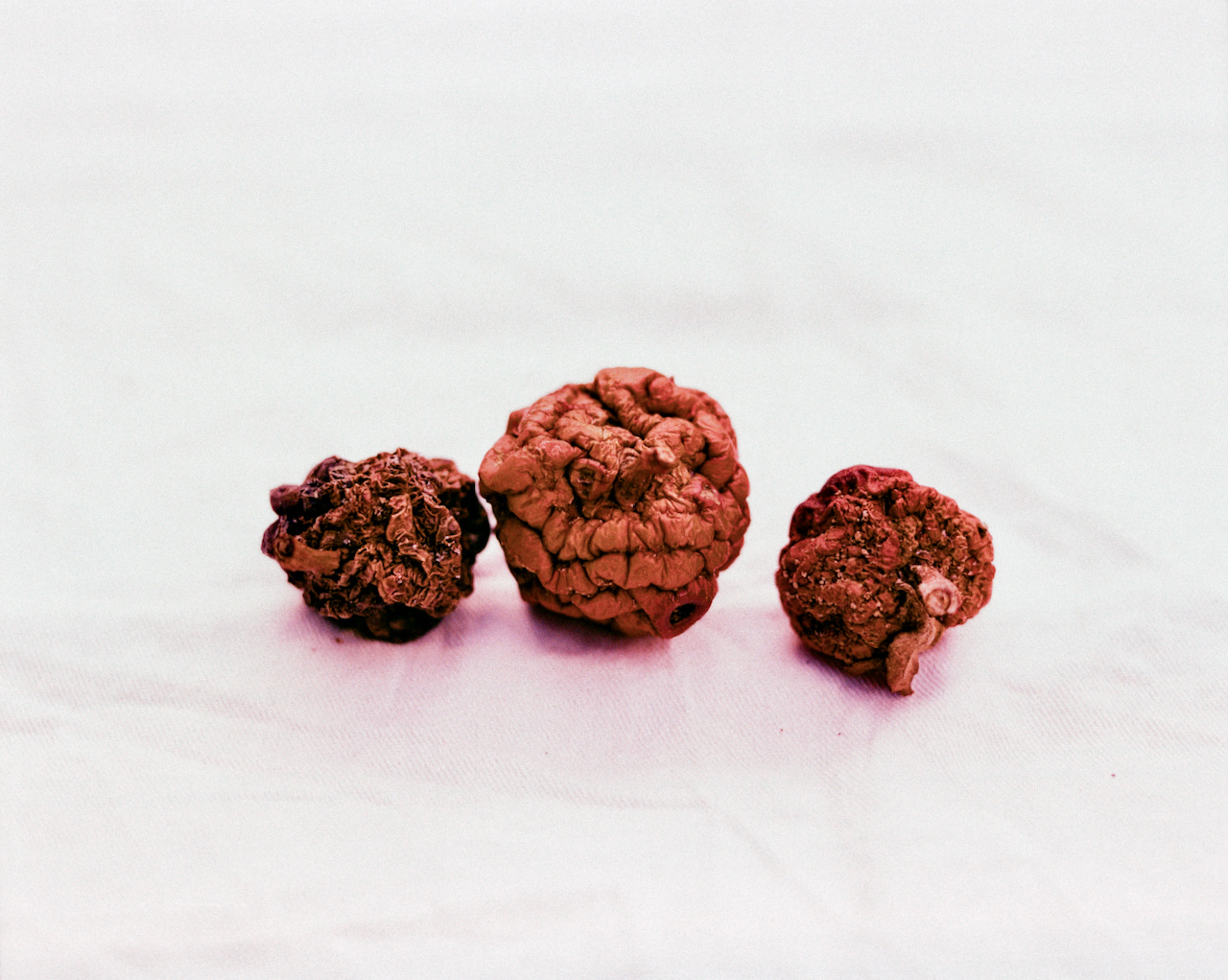
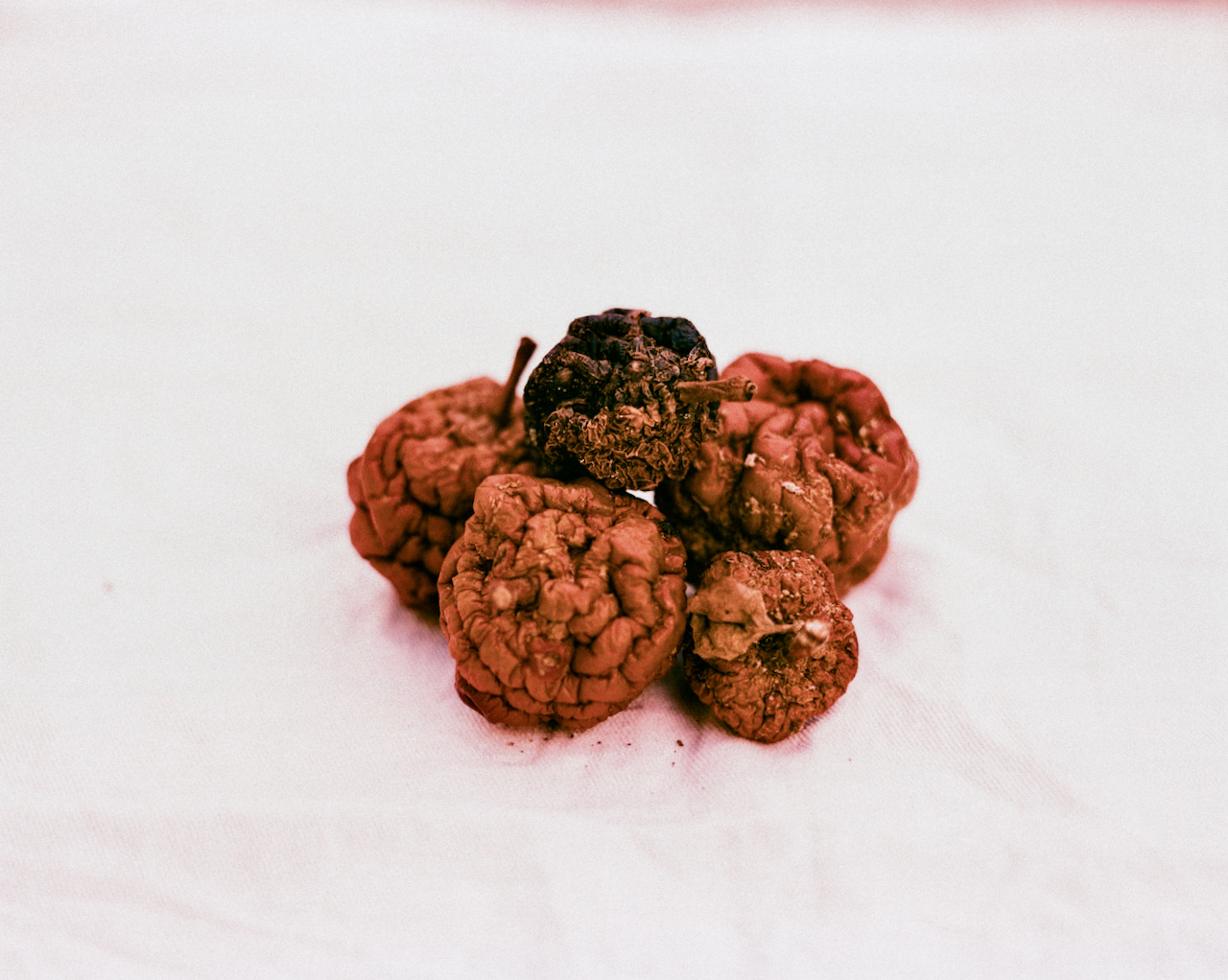
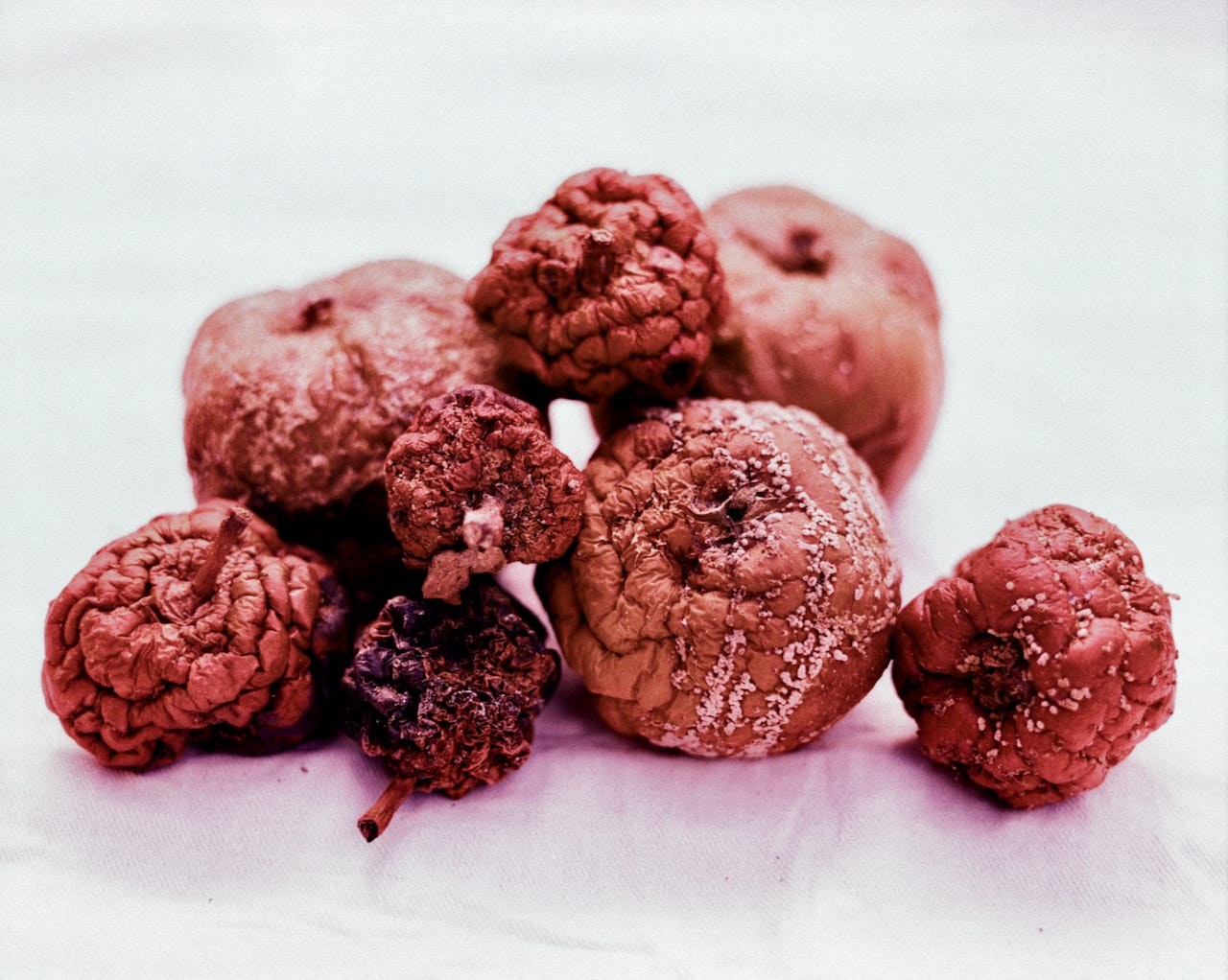
As you can see, I had the transparency film cross-processed. The lovely Stuart at Snappy Snaps advised me that the film would likely have a strong red colour cast.5 The rotting apples were already a reddish-brown colour. Maybe the cross-processing would further enhance their russety decrepitude?
this sense: the act of thinking, looking, and talking about what you see changes what you know and see.
― Alva Noë
When I looked through the film scans, specifically the cross-processed pictures, it occurred to me that they might help me think about Noë’s concepts of entanglement and looping.6 Since I am still working through the book, what follows is a very simplistic, amateur interpretation. I may return to the book in a future post. Bear with me.
Humans look at things in order to “organise” their activities and (from an evolutionary point of view) manage their survival. This is a first order process.
Perception is an embodied phenomenon and relational achievement. We aren’t simply inside our own heads, watching the world through a window. It is something we do. “[…] it isn’t the case the world shows up in our visual consciousness in sharp focus and uniform, high-resolution detail … as it might be rendered in a drawing or a photograph.”
We can alter how we perceive something by changing our viewpoint, to help things “show up” for us, or bring them into focus.
Art (like philosophy) is a second order process. Art “displays” the act of looking. It is a “disruption” of the organisation of looking. It “re-organises” it. This process of organisation through disruption to reorganisation is referred to as “looping”.
Art and life are entangled. “To say that art and life are entangled is to propose not only that we make art out of life — that life supplies art’s raw materials — but further that art then works those materials over and changes them. Art makes life new.” As with ironic language, works of art have the potential to transform the mundane, revealing it to us in new ways that, in turn, alter our understanding of everyday life.
it is this entanglement […] the transformation of the ways that we are organised by reflective resistance to the ways that we find ourselves organised — that is the key to understanding our true nature.
— Alva Noë
When I first encountered the windfalls, my intention was to get rid of them, to avoid having to step on them and sense their slimy flesh on the soles of my slippers, or smell the sweet stench of their rotting bodies. I wanted to deny wasps a reason to congregate in the garden. This is my habitual way of responding to windfalls, as a mild irritant or chore. However, this time, for some reason, they showed up for me and I decided to celebrate this with some photographs. I used a new camera and film, both unfamiliar to me.7 This disrupted my usual photographic habits. Once the pictures had been made, I took a risk on an unusual development technique, causing unexpected shifts in colour. The cross-processed film scans altered my perception of the windfalls. My habitual perceptions were re-organised.
The idea is that vision is remade in the setting of pictoriality in something like the ways that thought is remade in the setting of language.
— Alva Noë
I recently posted a quotation from an article by Jeanette Winterson in my Notes:
Yesterday marked my final day of pensionable service. I begin a new, part-time, role in the same school on 1 September and hope to continue teaching for a little while longer. I’m in my own harvesting phase. I would be fascinated to know if any of the above strikes a chord with you and if Noë’s ideas (however poorly represented here) and/or the images above ‘speak’ to you in any way.8
How do you feel about the entanglement of art and life? Do you think art has the power to “make life new”? You would be forgiven for feeling a little despondent about the current state of the world, so I’m thankful to Alva Noë for providing me with a few more reasons to put my faith art and philosophy.
These posts will always be free but, if you enjoy reading them, you can support my analogue photography habit by contributing to the film fund. All donations of whatever size are very gratefully received. Thanks to everyone who has already contributed and sent messages of encouragement!
I’m a photography teacher in a London secondary school. For a while I had some line leadership responsibilities for the arts and creativity. I had the pleasure of collaborating with some fantastic science teachers who were themselves creative thinkers and keen to explore the inter-disciplinary connections between our two curriculum areas. However, I’ve also encountered scientists who have been less sympathetic. I had a small row in the staff room with one, for example, who claimed that the infamous wobbly bridge was the result of having involved a famous sculptor in the design process. I suggested that it might also have had something to do with the engineers.
That’s what the summer holidays are for, right?
The Velvia was a gift from a colleague. I’m really impatient when it comes to developing and scanning so take my film to Snappy Snaps. I can get C-41 film developed and scanned the same day. I wasn’t sure about the E-6 transparency turnaround time when I shot the film.
Stuart runs the excellent Snappy Snaps in Covent Garden which I frequent very regularly and highly recommend. Since it would take two weeks (or more) to have the slide film processed in E-6 chemistry, I decided to take a punt on C-41 instead.
Looping is a concept generated by philosopher Ian Hacking in the 1980s to describe the ways in which people and psychological disorders are inter-dependent or “entangled”. Noë uses the term looping to describe “how art loops down and changes that of which it is the representation and how this is productive and potentially emancipatory.”
I’ve used XP2 before but not the Velvia 100 colour transparency film.
I’m making no claims for their artistic value other than as potential examples of entanglement.
As a serial disrupter of organised looking I found your apples to be pure sculpture!
I had a strange experience yesterday, which coincidentally happened at the end of summer. I'm hoping autumn to treat me a little better, so I can be focusing on all kinds of harvesting - metaphorical or not.